Want to know more about the NSW Southern Highland Scottish ghost town of


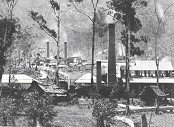
In the late 1800’s Joadja Creek and the Australian Kerosene Oil and Mineral Company flourished on coal and shale products it mined and manufactured for local and overseas use. Families were enlisted from the mining areas of Scotland and transported to the isolation of Joadja Creek. Today only the ghostly remains of buildings, photographs and stories from descendants tell of the 2000 people who once lived in this remote valley.
Years after its closure questions are still asked
-
Who lived and worked there?
-
How innovative was their manufacturing?
-
How did they survive the hardships?
-
What can we learn from the valley today?
Your questions are now answered
Since 1974 Leonie Knapman of Mittagong, has researched and recorded the history of this fascinating industry and its Scottish residents. In 1988 she published a full history, in 1996 a pictorial guide to all the ruins and in 1997 a half-hour Video and now a DVD of this turbulent time in Australian history.
JOADJA'S PAST and PRESENT
The year 1878 marked the beginning of the Australian Kerosene Oil and Mineral Company, possibly the largest and richest of NSW pioneering industries. Retorts and refining plants for the extraction of oil from shale were set up, with buildings erected to house machinery, and Scottish workmen. The company introduced large-scale production methods and solved their transport problems, by building a 30km narrow gauge railway to Mittagong. The company produced kerosene, candles, wax, oils and other products that had earlier been imported.
A village was established, and labour shortages over come by enlisting experienced workmen and their families from mining areas of Scotland. After arriving in Australia they were taken by horse or bullock team to Joadja Creek, where the retained their Scottish habits and customs.
Because of its isolation the village became self-sufficient and was one of the first country areas to have the telephone connected. A successful sideline was the 6700 fruit trees which supplied local and export markets.
Over the next 12 years it seemed as though no influence from the outside world would deter this industrial community from achieving success. But it did! Production ceased in the early 1900s when the newly formed Federal Government dealt it a deathblow by removing the duty on imported kerosene effectively killing another Australian industry in favour of overseas trade. By 1911 it was gone.
Little is recorded on many ghost towns and so their stories disappear. For Joadja Creek and The Australian Kerosene Oil and Mineral Company this is not the case. Painstaking scrutiny of old photographs, searching through Government journals, interviewing of descendants and advertising in newspapers, has gained a great deal of information on Joadja Creek, its industries and residents. Today the site is an important archaeological and historical resource for all ages. It has potential to demonstrate themes such as the introduction and adoption of technology to the harsh and unforgiving Australian bush and the living conditions of employees and their families. The site is now Heritage listed and on the National Estate Register. Today the valley is a captivating window into the past and through this window it provides a unique insight for young and old.
 Soft Cover $35.00
Due to popular demand this 176-page history has been reprinted a number of times. Hundreds of black and white, and colour photos, plus 2000 names bring alive the people who once lived at Joadja Creek and worked for the Australian Kerosene Oil and Mineral Company in the 1800s. Following is the forward, written by Sir Ian McFarlane, Chairman & Managing Director for Southern Pacific Petroleum Ltd. for the second edition when reprinted in 1997.
“It was my pleasure to write the Forward to the first edition of this excellent book, which details some of the history of Joadja Creek, the site of a thriving oil shale industry and a focal point of migration from Scotland to Australia in the late 1800’s. It is an even greater pleasure to write a second Forward for this second printing of the book.
When writing that Forward in 1988, I anticipated that Joadja Creek story would be a success, it is a delight to see its wide circulation of 6,000 copies and to know that it required a second printing.
Much of the success of the book lies with the author, Leonie Knapman. Her many years of dedication to the research of Joadja Creek has continued even after the first printing of the book. Much of the character of Leonie comes through in the book – her dedication, her irrepressible vitality and energy, her delight in finding and recording the detail in the records, and her need to share her love of Joadja Creek with others.
Those of us who are dedicated to the rebirth of a second Australian oil shale industry were proud to be associated with Leonie Knapman and her fine book about our heritage at its first launching. We are even more delighted that a second printing of the first book is needed. We know that those who purchased this book will be rewarded with a pleasurable reading of our past heritage.
Congratulations Leonie, a job well done”.
 DVD Joadja Creek $25.00
This interesting DVD brings alive all the 1870’s Scottish settlers and their struggle to establish an industry and township in this isolated valley far from civilisation. The open weekend in 1996 is featured along with interviews of descendants.
This remote valley and its ‘Rocks’ that burn comes alive as the viewer seeks to find the reason for the rise and fall of this mystic shale mining settlement. See how they lived and worked to harness the oil shale for much needed lighting in the colony. This stimulating and entertaining DVD includes glimpses of:
-
The shale oil industry that made Joadja Creek one of the largest producers of products in NSW during the 1800s.
-
Stories of the Scottish families who came to this remote area of Joadja Creek to make a new life for themselves.
-
Hundreds of photographs brought to life with narration of families who made their home in the Australian bush.
-
Ten miles of railway, which net worked the valley from the mining shelves to the incline and valley floor.
-
Soccer match playing for the cup won at Joadja in 1887.
-
March 1996 open weekend when 11,000 people ‘came home’ if only for the weekend.
-
Interviews with descendants who attended the open weekend (for many it was their first visit)
-
3801 Steam train arriving at Mittagong with railway enthusiasts and descendants bound for Joadja Creek.
-
The “D” type retorts shown are the last known to exist in Australia and possibly the world and are now listed on the National Estate Register and Heritage listed.
-
Views of Brigadoon that appear from the mist once a year at Bundanoon in the Southern Highlands.
 Guide to Joadja Creek $10.00
No ghost town visit is complete without a guide to remind you of your visit. This 24-page booklet of Joadja Creek features a map identifying ruins by letters matching those above photographs on each page.
This photographic booklet helps the visitor understand and appreciate buildings and ruins that now cover the property once owned by the Australian Kerosene Oil & Mineral Company.
The coloured front and back covers depict Joadja Creek as it is today. Inside black and white photos taken over 100 years ago bring the valley alive.
There is no way visitors can remember all the beauty and history of Joadja Creek in one visit, so why not take home a photographic and informative booklet to keep forever as a memento of this fascinating Scottish industry and settlement.
