Shale mining ghost town of Glen Davis
National Oil Pty Ltd (NOP)
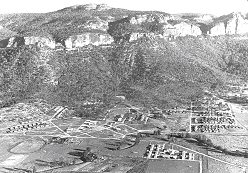
Set in the Capertee Valley, Glen Davis is located northeast of Lithgow in the Blue Mountains. The Capertee River cuts through the valley as it travels to the Colo River and to the coast. The valley is approximately 300 metres above sea level with stunning 500 metre sandstone cliffs towering above it. Although oil shale was discovered and worked in the Capertee Valley before 1900 production did not come into prominence until the formation of National Oil Pty Ltd in 1937.


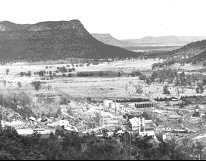
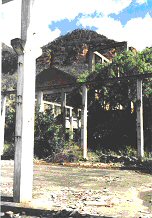
After leaving Glen Davis in December 1954 I thought often of my childhood spent in the beautiful Capertee Valley and the people who lived and worked at Glen Davis. It was not until the late 1960s that I returned home for the first time and found you cannot do this without some trepidation. Memories of Glen Davis as a busy township crashed around my feet as I walked amongst the ruins, the forgotten and empty streets and the vacant block, which was once the site of my home.
Most of the hard times of the town's residents passed over the heads of their children and it is only now researching the history of Glen Davis that I appreciate their frustrations. Families were coming out of the depression into a wartime situation and a life of rationing of petrol, tyres, food and clothing. This was further compounded by drought followed by almost 30 floods.
I have tried to look at what makes people choose the mining life and live in remote areas foregoing the comforts of life in the larger towns or cities. Men came from all walks of life to search for work and not all were familiar with the physical grind of the mining industry and its drawbacks. Whatever their background those who stayed shared a bond that only comes from a close knit and isolated population.
This book is not written to determine who or what caused the downfall and destruction of NOP at Glen Davis. It is to show the tenacity and strength of those who lived and worked there from 1938 to 1954 when everything was auctioned off and many families walked away with nothing. Two World Wars has brought Australians an awareness of the value of our historical records whether they are found in the diaries of private citizens, company memos and minutes or public records. The National Archives have been a great source of information and it is interesting to see what went on behind the closed doors of the Governments who served from 1937 to that disastrous day in January 1951 when the Menzies Government announced Glen Davis was to close after using it as a political football for so long.
The manufacture of oil from shale has a long history in Australia commencing at America Creek near Wollongong on the South Coast of New South Wales in 1865. Shale oil became our first secondary industry employing one out of every 1000 Australians by 1880. The industry was based on retorting (heating) oil shale found in the mountains at Joadja, Hartley Vale, Torbane, Newnes and Timor near Murrurundi. The richness of the shale allowed labour intensive underground mining and efficient retorting procedures to be economically viable. Initially kerosene was the main commodity distilled from the oil shale together with paraffin wax for candles. Later as Australia's car population grew, petrol became the most important product and during World War II a plant was established at Glen Davis to produce petrol.


While the Glen Davis works was partly a response to the unemployment of the depression years of the 1930s the works took on a greater significance with the onset of war when the vulnerability of Australia's oil supplies was clearly demonstrated. The Government of the day should be given some credit for its foresight. After the war Glen Davis was living on borrowed time. It had consumed large amounts of public money and the operation became increasingly uneconomical. The Commonwealth Government had nationalised the venture in the war years and had invested a lot of money to upgrade the refinery. By 1947 designed capacity had increased to ten million gallons of motor fuel however in that year only four million gallons were produced. By 1950 output was down to 2.4 million gallons. By 1951 the annual output from the Glen Davis refinery was equivalent to one day’s petrol consumption Australia wide. Production cost five shillings and three pence a gallon; petrol could be imported for one shilling and three pence a gallon. The main problem was not so much the refining process but the inability to increase oil shale output from the mines.

The closure of NOP should not have come as a surprise to everyone. It had been troubled for years and was kept operating at a loss for political reasons. If the miners had lifted the darg on output of shale it may have survived for a little longer.
When the government mooted closure of the company it sparked state wide controversy and workers took matters into their own hands. On the night of 12 June 1952 fifty two miners began a stay-down strike lasting 26 days. It was the longest stay in strike in Australian history. In spite of the efforts of the Commonwealth authorities to shut down the retorts they mysteriously kept working to prevent their dismantling. The authorities removed the power fuses to force the retorts out of action but they were replaced just as quickly and shale for the retorts seemed to appear from nowhere. The day the strike ended was an emotional one. A large crowd of families and visiting miners waited as the men emerged on electric loco hauled transports. Unfortunately their efforts and discomfort were in vain. The closure still took place. It was the last straw for the residents who thought their homes and jobs were secure.
Today, over fifty years later, the valley has returned to farming and grazing as it had been since the 1800s, a far cry from the turbulent fourteen years of NOP. Glen Davis has been stripped of its town status. It is as if the Government had tried to wipe it off the face of the earth. To the thousands who lived in the valley it represents more than a shale mining ghost town - it is part of their past and it is not difficult to see why they return time and time again.
